

Implement responsible sourcing
Consumers have a right to know where their food comes from, and how it was sourced.
Our commitment
Implement responsible sourcing in our supply chain and promote animal welfare

Responsible Sourcing indicates ethical, environmental, and social responsibility throughout the supply chain. This approach promotes resilient agricultural practices, conservation of natural resources, and improved livelihoods for farmers. Nestlé India continues to partner extensively with coffee, cocoa and palm value chain partners and farmers to procure sustainably grown raw materials.
It continues the immersive work with coffee farmers across Karnataka, Kerala and Tamil Nadu in India in guiding them on farming practices thus propelling the Company towards its ambition of sourcing 100% sustainably sourced coffee, palm and cocoa.
Dairy Entrepreneurship and Responsible Sourcing Programme
Since dairy forms one of the key ingredients for the market, and contributes significantly to the emission footprint, we have made efforts to procure high quality fresh milk from farmers, providing market access and fair prices round the year. The Fresh Milk Procurement and Dairy Development (FMPDD) project spans across around 60,000 sq. km in Punjab, Haryana, and Rajasthan, engaging with ~80,000 dairy farmers to enhance productivity and quality through technical assistance, veterinary services, and access to medicines.
The Sustainable Dairy Project is a holistic initiative aimed at tackling major challenges in dairy farming, including low productivity, scarce quality feed and fodder, insufficient farm infrastructure, high greenhouse gas emissions, lack of technical expertise, and restricted access to financial resources. The project, focusing on key pillars was initiated in 2022-2023, and was aimed at enhancing farm productivity and income through climate-resilient practices, empowering farmers to become ‘agripreneurs’.
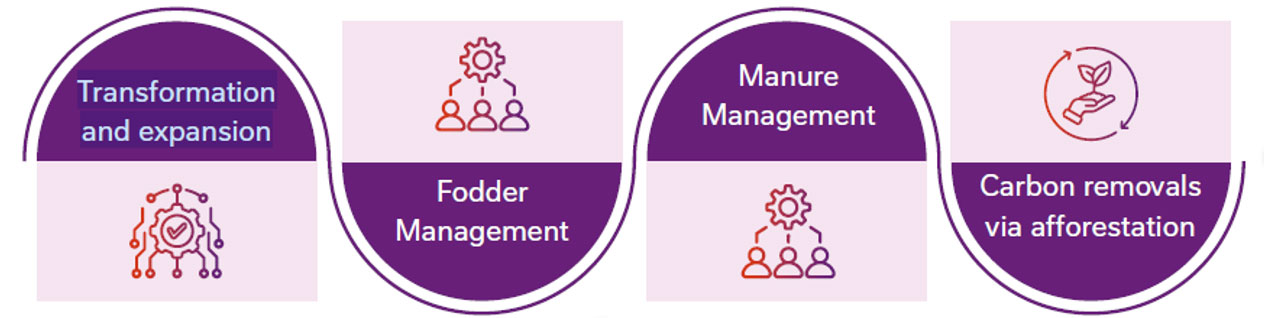
This project focuses on implementing advanced farming practices, technologies, and management systems to increase milk productivity and enhance livelihood for the dairy farmers. More than 1,100 farmers associated with Nestlé India accelerated their transformation journey during 2024-2025. The project focuses on nutrition enhancement and improved animal health through on-farm disease testing, digital health monitoring, and expert vet support. The project includes running training programmes for farmers to roll out the newer techniques, and pilot new practices and technologies to track improvements in performance.
The Company aims to reduce emissions from manure by installing anaerobic biodigesters, generating renewable energy, and improving manure management. Over 5,800 small and 200 large biodigesters have been installed by the end of 2024-2025, reducing methane emissions and promoting sustainable farming practices.
Sustainable Rice, Wheat, and Sugar
Partnering with IFFCO Suvidha Private Limited, the Sustainable Paddy Project in Telangana and Madhya Pradesh engaged more than 800 farmers, focusing on climate, soil, water, inputs, energy, residue management, and farmer competency. It positively impacted livelihoods through sustainable agriculture t raining via workshops and demonstrations. Additionally, with the guidance of Landmark Agri, Nestlé India is running the Sustainable Wheat Project in Punjab and Uttar Pradesh. This Project is helping approximately 900 small farm holders transition from traditional farming. This initiative promotes sustainable, economically viable farming, enhancing soil health, water efficiency, and climate-friendly practices. Addressing sugar supply chain environmental challenges, the Company initiated regenerative agriculture with more than 1,400 farmers across 3 sugar mills in its sourcing areas. The project reduces GHG emissions by improving soil, water, inputs, energy use, and residue management, while enhancing farmer skills. A key component of this project is promoting sustainable practices through Bonsucro Certification.
NESCAFÉ Plan
The NESCAFÉ Plan was initiated in 2012, as a tangible effort of how Nestlé India Create Shared Value (CSV) in the coffee sector for farmers, communities and its planet and its commitment to continuously support responsible sourcing and increasingly sustainable value chains. Through the NESCAFÉ Plan, the Company assists in ensuring long term supply of quality green coffee by making coffee farming a more attractive activity for the present and future generations as well as improving the environmental footprint. Read more here: NESCAFÉ plan - Improve our green coffee supply chain | Nestlé
MAGGI Spice Plan
MAGGI Spice Plan aims to map the origins of our spices, uphold quality standards across their supply chains, and promote better and regenerative agricultural practices. In India, the programme is also driven with a focus on enhancing the sustainability and economic resilience of farming communities that grow these key spices.
Rooted in the principles of planet, people and profit, the Responsible Sourcing Programme seeks to take a bold and systemic approach at transforming the spice supply chains; with interventions aimed at reducing the use of pesticides and harmful chemicals, improving soil health, increasing water-use efficiency, and restoring biodiversity in and around farm landscapes—all while enhancing farmers’ livelihoods and long-term resilience.
The programme has already positively impacted around 2,500 farmers across 8 states, with 10 of our key spices being 100% traceable. As a part of The MAGGI Spice Plan, Nestlé India sources 10 key spices from suppliers with ‘Backward Integration Programs’ (BIP) traceability and Integrated Pest Management (IPM) in place [farmer monitoring, focused on practices to ensure Maximum Residue Limit (MRL) compliance- food safety]. Supplier’s BIP and traceability includes field extension support for Integrated Pest Management (IPM) programmes of participating farmers e.g., Suppliers’ Agronomists’ daily/ weekly visits to farmer fields and data gathering. This provides a good foundation for implementation of Good Agricultural Practices (GAP). Nestlé India suppliers are key business partners in developing responsibly sourced supply chains of selected key spices. The Company has a Agri Supplier Development team that works through the Nestlé – Business Partners - Project Farmers model to create sustainable local sourcing. The team’s objectives include less reliance on imports, develop local and sustainable sourcing model with focus on compliance and creating shared value.
Related content
Find out more about our Global Commitments at
